
Rep. LaMonica McIver Files Appeal Notice Seeking to Toss Federal Charges in Newark ICE Facility Clash
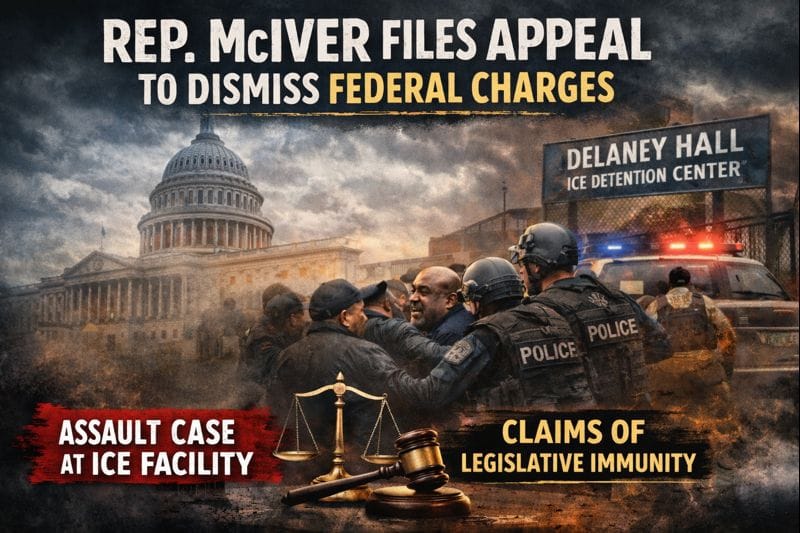
NEWARK, N.J. — U.S. Rep. LaMonica McIver (D–NJ-10) has filed a notice of appeal that would push her federal case to the U.S. Court of Appeals for the Third Circuit, as she continues fighting charges tied to a chaotic confrontation outside Newark’s Delaney Hall immigration detention facility.
McIver’s appeal notice comes after U.S. District Judge Jamel Semper denied major parts of her effort to dismiss the indictment. Notably, Semper denied dismissal on Counts One and Three, while withholding a decision on Count Two pending additional review—meaning the case is still partly unresolved at the trial-court level even as the appeal notice is filed.
What prosecutors allege happened at Delaney Hall
Federal prosecutors say the confrontation happened May 9, 2025, during a congressional oversight visit at Delaney Hall that coincided with a protest. According to the U.S. Attorney’s Office, Newark Mayor Ras Baraka entered the secured area, was told he wasn’t authorized to be there, and was warned multiple times he would be arrested if he didn’t leave. Prosecutors allege McIver and others protested his removal, and when officers moved to arrest Baraka, McIver and others surrounded him and blocked efforts to handcuff him.
In the government’s version, McIver allegedly placed her arms around Baraka to prevent the arrest and made physical contact with officers, including striking with her forearm and grabbing an officer, and later using her forearms to strike a second officer. McIver has pleaded not guilty and disputes the characterization of events.
The charges and potential penalties
A federal grand jury charged McIver in a three-count indictment. Prosecutors say she faces up to 8 years on Count One, up to 8 years on Count Two, and up to 1 year on Count Three—a theoretical maximum of 17 years if imposed consecutively. The DOJ also emphasizes that an indictment is an allegation and defendants are presumed innocent.
The legal fight: “legislative immunity” vs. “not oversight”
McIver’s appeal is expected to focus on legislative immunity arguments (Speech or Debate Clause-style protections), with her saying the case targets congressional oversight.
But in his Nov. 13 ruling, Judge Semper rejected the idea that the alleged conduct during Baraka’s arrest was protected oversight—writing that “Impeding an arrest, whether lawful or unlawful, goes beyond any reasonable definition of oversight” and that “No genuine legislative purpose was advanced” by the alleged conduct supporting Counts One and Three.
The judge also denied McIver’s claims seeking dismissal based on selective/vindictive enforcement at this stage.
Baraka case dropped — and a judge called it “embarrassing”
Mayor Ras Baraka was initially charged with trespassing, but federal prosecutors dropped that case. In a separate hearing, a federal magistrate judge dismissed the complaint with prejudice and sharply reprimanded prosecutors, calling the reversal “embarrassing” and warning that arresting a public figure should never be used as a shortcut investigative tool.
What happens next
A notice of appeal is the formal step that begins the appellate process; substantive briefing comes later. The Third Circuit will ultimately decide whether McIver’s appeal can proceed now and, if so, whether the legal protections she claims require any or all charges to be dismissed. Meanwhile, the underlying federal criminal case remains pending in Newark, including the still-unresolved Count Two issue.
Here at GSG, we don’t put sugar in our coffee.
Member discussion