
THIS IS SCARY: New Street Poison Is Quietly Moving Through New Jersey — And It Makes Fentanyl Look Mild.
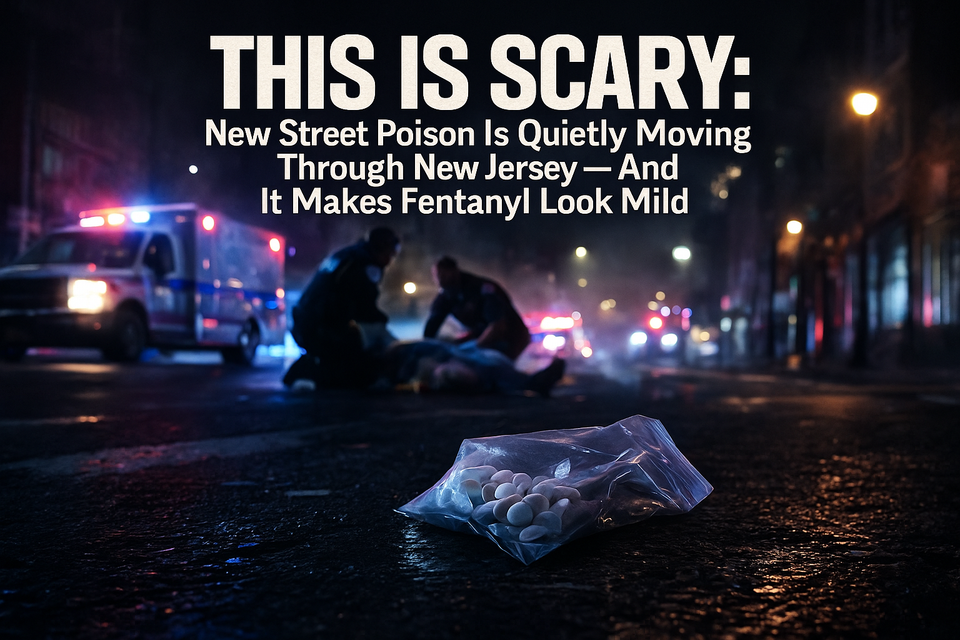
TRENTON — New Jersey’s overdose war just got uglier.
A new class of synthetic opioids called nitazenes has started showing up in street drug samples — and federal officials say some versions can hit up to 40 times stronger than fentanyl.
Doctors are reporting people dropping within seconds, needing layered doses of Narcan and sometimes full ventilation just to stay alive. This isn’t the next chapter of the fentanyl crisis — it’s a new book.
What Is Nitazene — And Why Is It So Dangerous?
Nitazenes are a family of lab-made opioids first cooked up in the 1950s and never approved for medical use. Now they’re back as a designer street drug, blended into powder and pills that users often mistake for regular fentanyl or heroin.
Federal health agencies say certain nitazene analogs can dramatically outmuscle fentanyl at the brain’s opioid receptors, meaning:
- Overdoses happen faster
- Breathing can shut down almost instantly
- Standard Narcan responses are less reliable and may need to be repeated
The Drug Enforcement Administration (DEA) has already moved to classify multiple nitazenes as Schedule I — the government’s harshest category — because of their high abuse potential and lack of accepted medical use.
“Already Here”: New Jersey Treatment Providers Sound the Alarm
This isn’t a distant Midwest problem anymore — it’s already inside New Jersey’s borders.
South Jersey treatment provider Green Branch Recovery is warning that nitazenes are now part of the local drug supply and are already contributing to overdose deaths. They describe nitazenes as a “new and more dangerous turn” in an opioid epidemic that refuses to slow down.
The warning lines up with national data:
- The CDC reports nitazenes are showing up in toxicology reports across multiple states.
- These compounds are being cut into fentanyl, mixed with other synthetic opioids, and often combined with the animal tranquilizer xylazine, creating a chaotic cocktail where users have no idea what they’re actually taking.
For New Jersey, that means someone chasing a familiar high could be swallowing a dose tailored for the morgue.
First Responders: “Seconds to React, Not Minutes”
Emergency rooms across the country have started reporting a distinct pattern:
- Patients collapse almost immediately after using.
- Standard Narcan doses don’t always snap them back.
- Some overdoses require stacked Narcan or prolonged ventilation to keep people alive.
The DEA describes nitazene mixtures as unpredictable and catastrophic, with reported side effects including:
- Sudden respiratory failure
- Rapid loss of consciousness
- Severe muscle rigidity
- Skin ulcers that can appear far from injection sites, raising questions about toxins in the supply chain
For cops, EMTs, and firefighters from Camden to Paterson, that means the overdose window — the time between “something’s wrong” and “too late” — is shrinking.
Congress Moves To Lock Nitazenes Down
Washington has noticed.
A bill in the U.S. House, H.R. 5032 – The Nitazene Control Act, aims to permanently classify nitazenes and related compounds as Schedule I controlled substances under federal law.
The bill’s key points:
- Formally defines nitazenes as benzimidazole-opioids, a highly potent synthetic opioid class
- Locks the entire nitazene family into Schedule I — not just individual analogs
- Tries to stay ahead of the game by covering new nitazene look-alikes before they flood the streets
In plain English: Congress is trying to slam the legal door on this entire chemical family before the overdose curve spikes again.
Why New Jersey Should Treat This Like an Incoming Storm
Public health officials say the nitazene problem is being built by a perfect storm of factors:
- More potent drugs than what’s already on the streets
- Contaminated supply chains where users never know what they’re really getting
- Faster overdoses that give bystanders less time to react
- Low public awareness — most people have never even heard the word “nitazene”
- Seasonal isolation — as winter hits, more people are using alone indoors, where no one is around to call 911
New Jersey already knows what it looks like when a synthetic drug wave hits late: fentanyl carved its death toll into city after city. Nitazenes threaten to accelerate that same pattern — just faster and with less margin for error.
What Communities Need To Do Right Now
Health officials and addiction experts are pushing a simple message: treat every bag, pill, and line like it might contain nitazenes.
Key steps they’re urging:
- Carry naloxone (Narcan) if you use drugs, know someone who does, or live in a high-risk neighborhood.
- Call 911 immediately at the first sign of overdose — don’t wait to “see if they come around.”
- Assume the mix is hot. There is no way to eyeball a nitazene-laced batch.
- Push for testing and public alerts at the county level, especially in areas already hit hard by fentanyl.
From Trenton to the Jersey City waterfront, the overdose war has just changed weapons. Nitazenes are silent, brutal, and moving quietly through the supply chain.
Fentanyl was the warning shot.
This is the escalation.
Member discussion